







[Product description]
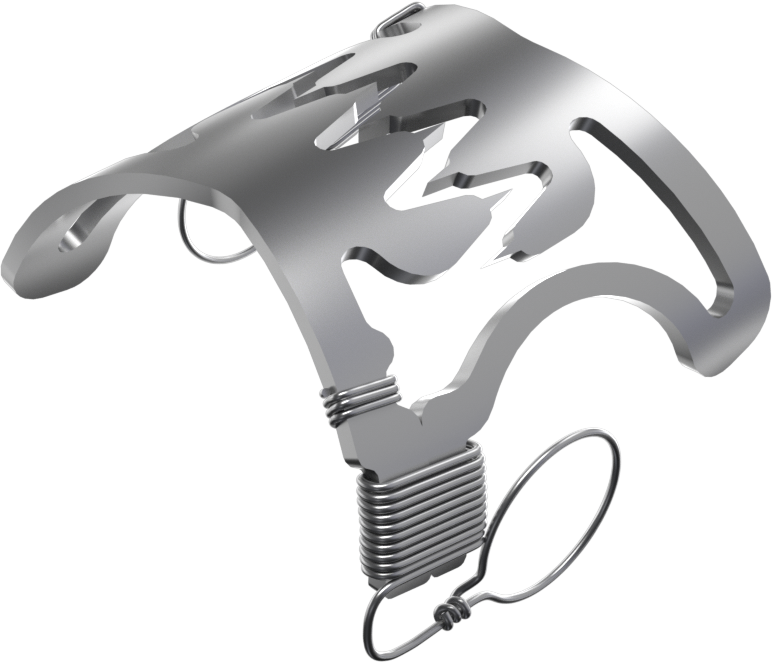
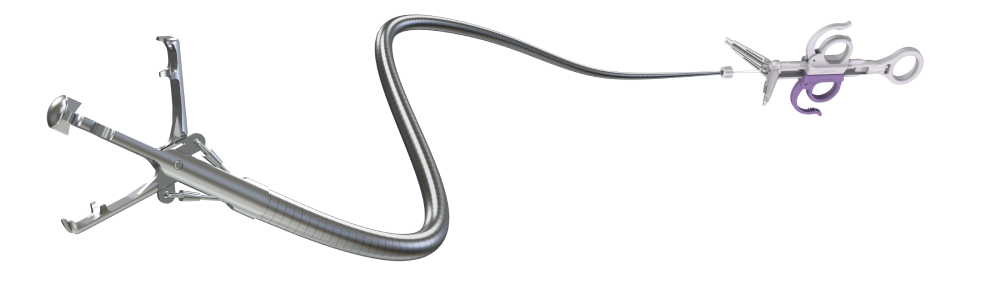
The Endoscopic Anastomosis Clip consists of an anastomosis clip preloaded onto an applicator cap, a releaser (depending on model), wire hooks (depending on model) and a protector cap (depending on model). The anastomosis clip consists of the occlusion jaws and the binding wires. The applicator cap consists of the transparent cap, the fixed sleeve and the threads. The releaser consists of the reel frame, the reel, the lock handle, the entrance sleeve, the inserting tube, the sealing cap and the Velcro tape. There are silicone sleeves on either end of the wire hook.
[Intended Use]
The Endoscopic Anastomosis Clip is an instrument for flexible endoscopy. It can be used for compression of tissue in the gastrointestinal (GI) tract, for hemostasis or for treating gastrointestinal organ wall lesions, and for endoscopic marking of lesions prior to gastrointestinal surgery.
[Intended User]
Clinicians trained in techniques necessary for the associated endoscopic therapeutic use of an over the scope clip and its potential adverse events.
[Intended Environment]
Endoscopy room or operating room.
[Indications for Use]
The Endoscopic Anastomosis Clip is an instrument for flexible endoscopy. It can be used for compression of tissue in the gastrointestinal (GI) tract, for hemostasis or for treating gastrointestinal organ wall lesions, and for endoscopic marking of lesions prior to gastrointestinal surgery.
The anastomosis clip is indicated for clip placement within the gastrointestinal (GI) tract for the purpose of:
- Endoscopic marking
- Hemostasis for:
- Mucosal/submucosal defects<3 cm
- Bleeding ulcers
- Arteries < 2 mm
- Polyps < 1.5 cm in diameter
- Diverticula in the colon
- Closure of GI tract luminal perforations < 20 mm that can be treated conservatively
[Patient Population]
Adults.
[Intended Clinical Benefits]
Clinical Success Rate- Hemostasis: 66.7-100%
Clinical Success Rate- Closure : 68.4-100%
[Contraindications]
1) Use of the clip device is contraindicated in any patient for whom flexible endoscopy is contraindicated;
2) Treatment of esophageal varices;
3) Patients with a known nickel allergy.
[Complications]
Perforation, tear, and mucosal / tissue Injury
Re-bleeding / hemorrhage
Failure, leakage, infection & inflammation
Device migration & procedure/placement issues
Pain and discomfort
[Specification]
The SI241 series products contain the releaser, the applicator cap, the anastomosis clip, the wire hook and the protector cap.
The SI244 series products are supplementary package for extra applicator cap with anastomosis clip.
Table 1 Specifications and Basic Sizes of Applicator Cap with Anastomosis Clip (Unit: mm)
Applicator cap specification | Max outer diameter | Tissue chamber depth | Matched endoscope tip diameter | Closure scope |
1506 | 15.5 | 6 | 8~10.2 | 0~15 |
1508 | 8 | |||
1706 | 17 | 6 | 8.5~11 | 0~20 |
1710 | 10 | |||
1906 | 19 | 6 | 10~13 | 0~25 |
1912 | 12 | |||
2106 | 21 | 6 | 12~14 | 0~30 |
2114 | 14 |
Table 2 Specifications of the Anastomosis Clips (Unit: mm)
Anastomosis Clip Model | Closure Width | Teeth Type |
A08 | 7.6 | Type A: Short sharp teeth |
B08 | Type B: Long sharp teeth | |
C08 | Type C: Blunt teeth | |
D08 | Type D: Lateral sharp teeth | |
A09 | 8.6 | Type A: Short sharp teeth |
B09 | Type B: Long sharp teeth | |
C09 | Type C: Blunt teeth | |
D09 | Type D: Lateral sharp teeth | |
A10 | 9.6 | Type A: Short sharp teeth |
B10 | Type B: Long sharp teeth | |
C10 | Type C: Blunt teeth | |
D10 | Type D: Lateral sharp teeth | |
A11 | 10.6 | Type A: Short sharp teeth |
B11 | Type B: Long sharp teeth | |
C11 | Type C: Blunt teeth | |
D11 | Type D: Lateral sharp teeth |
Table 3 Components of the SI241 Series Products
Model | Composition | Matched endoscope tip diameter (mm) | ||||
Releaser | Applicator cap | Anastomosis clip | Wire hook | Protector cap | ||
SI241-1506-A08 | 1 piece of SFQ | 1 piece of 1506 | 1 piece of A08 | 2 pieces of XG | 1 piece of BHM-17 | 8~10.2 |
SI241-1506-B08 | 1 piece of B08 | |||||
SI241-1506-C08 | 1 piece of C08 | |||||
SI241-1506-D08 | 1 piece of D08 | |||||
SI241-1508-A08 | 1 piece of 1508 | 1 piece of A08 | ||||
SI241-1508-B08 | 1 piece of B08 | |||||
SI241-1508-C08 | 1 piece of C08 | |||||
SI241-1508-D08 | 1 piece of D08 | |||||
SI241-1706-A09 | 1 piece of 1706 | 1 piece of A09 | 8.5~11 | |||
SI241-1706-B09 | 1 piece of B09 | |||||
SI241-1706-C09 | 1 piece of C09 | |||||
SI241-1706-D09 | 1 piece of D09 | |||||
SI241-1710-A09 | 1 piece of 1710 | 1 piece of A09 | ||||
SI241-1710-B09 | 1 piece of B09 | |||||
SI241-1710-C09 | 1 piece of C09 | |||||
SI241-1710-D09 | 1 piece of D09 | |||||
SI241-1906-A10 | 1 piece of 1906 | 1 piece of A10 | 10~13 | |||
SI241-1906-B10 | 1 piece of B10 | |||||
SI241-1906-C10 | 1 piece of C10 | |||||
SI241-1906-D10 | 1 piece of D10 | |||||
SI241-1912-A10 | 1 piece of 1912 | 1 piece of A10 | ||||
SI241-1912-B10 | 1 piece of B10 | |||||
SI241-1912-C10 | 1 piece of C10 | |||||
SI241-1912-D10 | 1 piece of D10 | |||||
SI241-2106-A11 | 1 piece of 2106 | 1 piece of A11 | 12~14 | |||
SI241-2106-B11 | 1 piece of B11 | |||||
SI241-2106-C11 | 1 piece of C11 | |||||
SI241-2106-D11 | 1 piece of D11 | |||||
SI241-2114-A11 | 1 piece of 2114 | 1 piece of A11 | ||||
SI241-2114-B11 | 1 piece of B11 | |||||
SI241-2114-C11 | 1 piece of C11 | |||||
SI241-2114-D11 | 1 piece of D11 | |||||
Table 4 Components of the SI244 Series Products
Model | Composition | Matched endoscope tip diameter (mm) | |
Applicator cap | Anastomosis clip | ||
SI244-1506-A08 | 1 piece of 1506 | 1 piece of A08 | 8~10.2 |
SI244-1506-B08 | 1 piece of B08 | ||
SI244-1506-C08 | 1 piece of C08 | ||
SI244-1506-D08 | 1 piece of D08 | ||
SI244-1508-A08 | 1 piece of 1508 | 1 piece of A08 | |
SI244-1508-B08 | 1 piece of B08 | ||
SI244-1508-C08 | 1 piece of C08 | ||
SI244-1508-D08 | 1 piece of D08 | ||
SI244-1706-A09 | 1 piece of 1706 | 1 piece of A09 | 8.5~11 |
SI244-1706-B09 | 1 piece of B09 | ||
SI244-1706-C09 | 1 piece of C09 | ||
SI244-1706-D09 | 1 piece of D09 | ||
SI244-1710-A09 | 1 piece of 1710 | 1 piece of A09 | |
SI244-1710-B09 | 1 piece of B09 | ||
SI244-1710-C09 | 1 piece of C09 | ||
SI244-1710-D09 | 1 piece of D09 | ||
SI244-1906-A10 | 1 piece of 1906 | 1 piece of A10 | 10~13 |
SI244-1906-B10 | 1 piece of B10 | ||
SI244-1906-C10 | 1 piece of C10 | ||
SI244-1906-D10 | 1 piece of D10 | ||
SI244-1912-A10 | 1 piece of 1912 | 1 piece of A10 | |
SI244-1912-B10 | 1 piece of B10 | ||
SI244-1912-C10 | 1 piece of C10 | ||
SI244-1912-D10 | 1 piece of D10 | ||
SI244-2106-A11 | 1 piece of 2106 | 1 piece of A11 | 12~14 |
SI244-2106-B11 | 1 piece of B11 | ||
SI244-2106-C11 | 1 piece of C11 | ||
SI244-2106-D11 | 1 piece of D11 | ||
SI244-2114-A11 | 1 piece of 2114 | 1 piece of A11 | |
SI244-2114-B11 | 1 piece of B11 | ||
SI244-2114-C11 | 1 piece of C11 | ||
SI244-2114-D11 | 1 piece of D11 | ||
Table 5 Compatibility Chart
Model | Applicator cap specification | Matched endoscope tip diameter of applicator cap | Matched Supplementary Package | Protector cap specification | Matched endoscope tip diameter of protector cap |
SI241-1506-A08 | 1506 | 8~10.2 | SI244-1506-A08 SI244-1506-B08 SI244-1506-C08 SI244-1506-D08 | BHM-17 | 9~12 |
SI241-1506-B08 | |||||
SI241-1506-C08 | |||||
SI241-1506-D08 | |||||
SI241-1508-A08 | 1508 | SI244-1508-A08 SI244-1508-B08 SI244-1508-C08 SI244-1508-D08 | |||
SI241-1508-B08 | |||||
SI241-1508-C08 | |||||
SI241-1508-D08 | |||||
SI241-1706-A09 | 1706 | 8.5~11 | SI244-1706-A09 SI244-1706-B09 SI244-1706-C09 SI244-1706-D09 | ||
SI241-1706-B09 | |||||
SI241-1706-C09 | |||||
SI241-1706-D09 | |||||
SI241-1710-A09 | 1710 | SI244-1710-A09 SI244-1710-B09 SI244-1710-C09 SI244-1710-D09 | |||
SI241-1710-B09 | |||||
SI241-1710-C09 | |||||
SI241-1710-D09 | |||||
SI241-1906-A10 | 1906 | 10~13 | SI244-1906-A10 SI244-1906-B10 SI244-1906-C10 SI244-1906-D10 | ||
SI241-1906-B10 | |||||
SI241-1906-C10 | |||||
SI241-1906-D10 | |||||
SI241-1912-A10 | 1912 | SI244-1912-A10 SI244-1912-B10 SI244-1912-C10 SI244-1912-D10 | |||
SI241-1912-B10 | |||||
SI241-1912-C10 | |||||
SI241-1912-D10 | |||||
SI241-2106-A11 | 2106 | 12~14 | SI241-2106-A11 SI241-2106-B11 SI241-2106-C11 SI241-2106-D11 | ||
SI241-2106-B11 | |||||
SI241-2106-C11 | |||||
SI241-2106-D11 | |||||
SI241-2114-A11 | 2114 | SI241-2114-A11 SI241-2114-B11 SI241-2114-C11 SI241-2114-D11 | |||
SI241-2114-B11 | |||||
SI241-2114-C11 | |||||
SI241-2114-D11 |
[MRI Safety Information]
The Endoscopic Anastomosis Clip has not been evaluated for safety in the MR environment. It has not been tested for heating or unwanted movement in the MR environment. The safety of Endoscopic Anastomosis Clip in the MR environment is unknown. Performing an MR exam on a person who has this medical device may result in injury or device malfunction. Since the anastomosis clip shall be removed from the body within 30 days, a patient can safely undergo an MRI examination once the anastomosis clip has been removed from the body.
[Warnings]
1. Please carefully read all instructions prior to use. Do not exceed the product indications to use.
2. Please carefully examine the integrity of the sterile package prior to use. Do not use the product if the sterile package is damaged.
3. The validity of the product is three years, prohibit using the expired product.
4. This product is disposable and single use only.
5. After use, the product may be a potential biohazard. Handle and dispose of in accordance with acceptable medical practice and applicable local, state and federal laws and regulations related to product contamination by blood.
[Precautions]
1. It is recommended to apply some lubricants to the applicator cap outer surface before deploy it into patients.
2. Mount the protector cap to capture the separated clip to avoid tissue scratch.
3. Based on clinical trials, 8.8% (9/102) of the clips can spontaneously fall off within 30 days.
4. Endoscopic follow-up is mandatory within 30 days. If the clip cannot spontaneously fall off within 30 days, it need to be removed from the body by endoscopic method.
[Steps Prior to Use]
1. Before assembly, check the compatibility of the endoscope and the applicator cap of the Endoscopic Anastomosis Clip with the label on the protective packaging and sales packaging.
Note: The Endoscopic Anastomosis Clip is designed for use with standard flexible endoscopes with a working channel diameter of at least 2,8 mm.
If the Endoscopic Anastomosis Clip is used in combination with an application aid (Endoscopic Twin Forceps), the working channel diameter has to be at least 2,8 mm.
2. Ensure that the packaging is unopened and/or undamaged and check the expiration date. In the case of damaged packaging, the product may not be used.
Note: If the components are damaged or defected, do not use.
3. Open the packaging and take parts out of the packaging.
[Directions for Assembly]
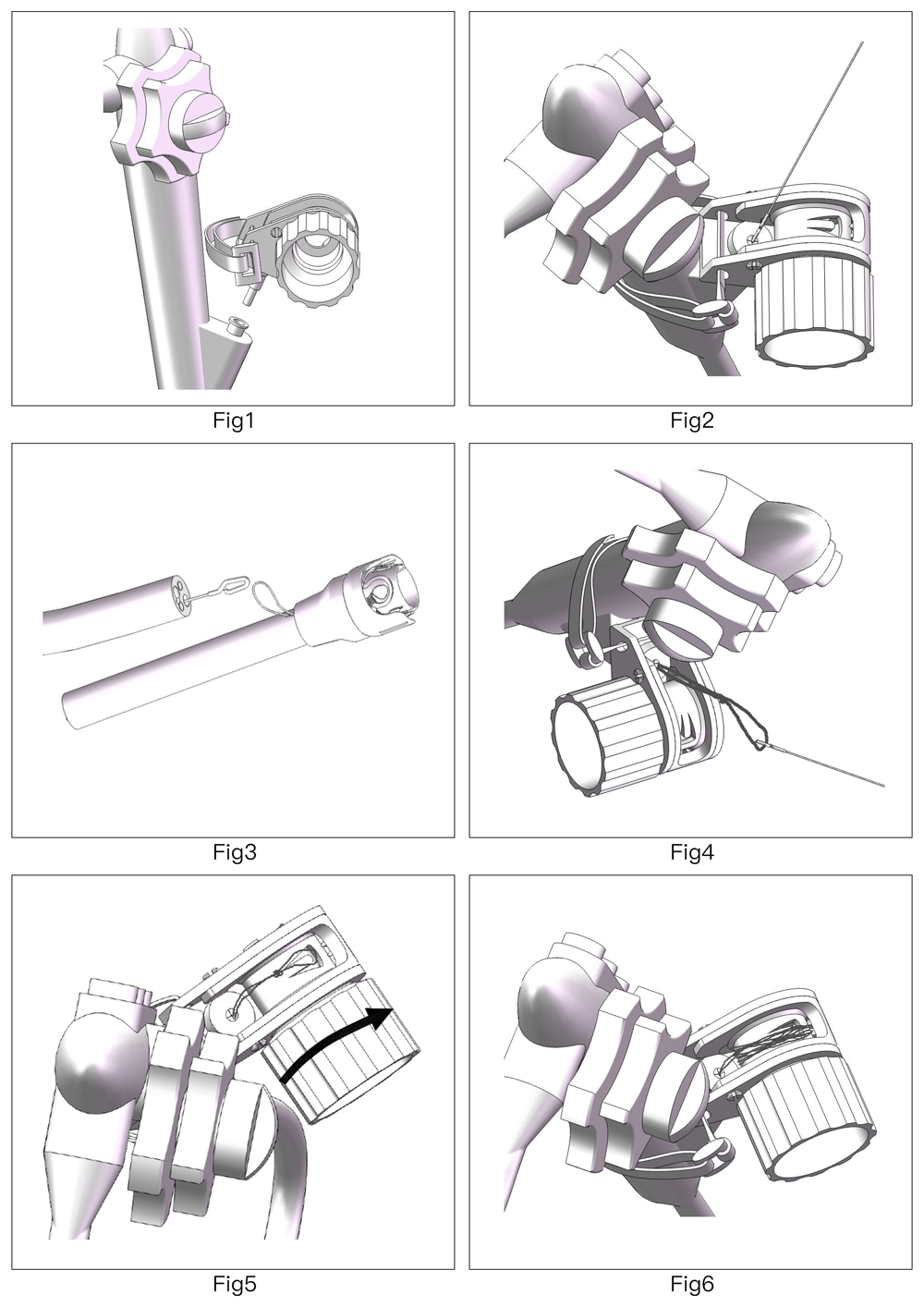
1. Mount releaser on the working channel of the endoscope. (Figure 1)
2. Attach the releaser’s Velcro Tape to the endoscope’s hand-hold. (Figure 2)
3. Insert the wire hook into the working channel. (Figure 2)
4. Grasp the thread knot with the wire hook. Pull the thread through the working channel. (Figure 3& Figure 4)
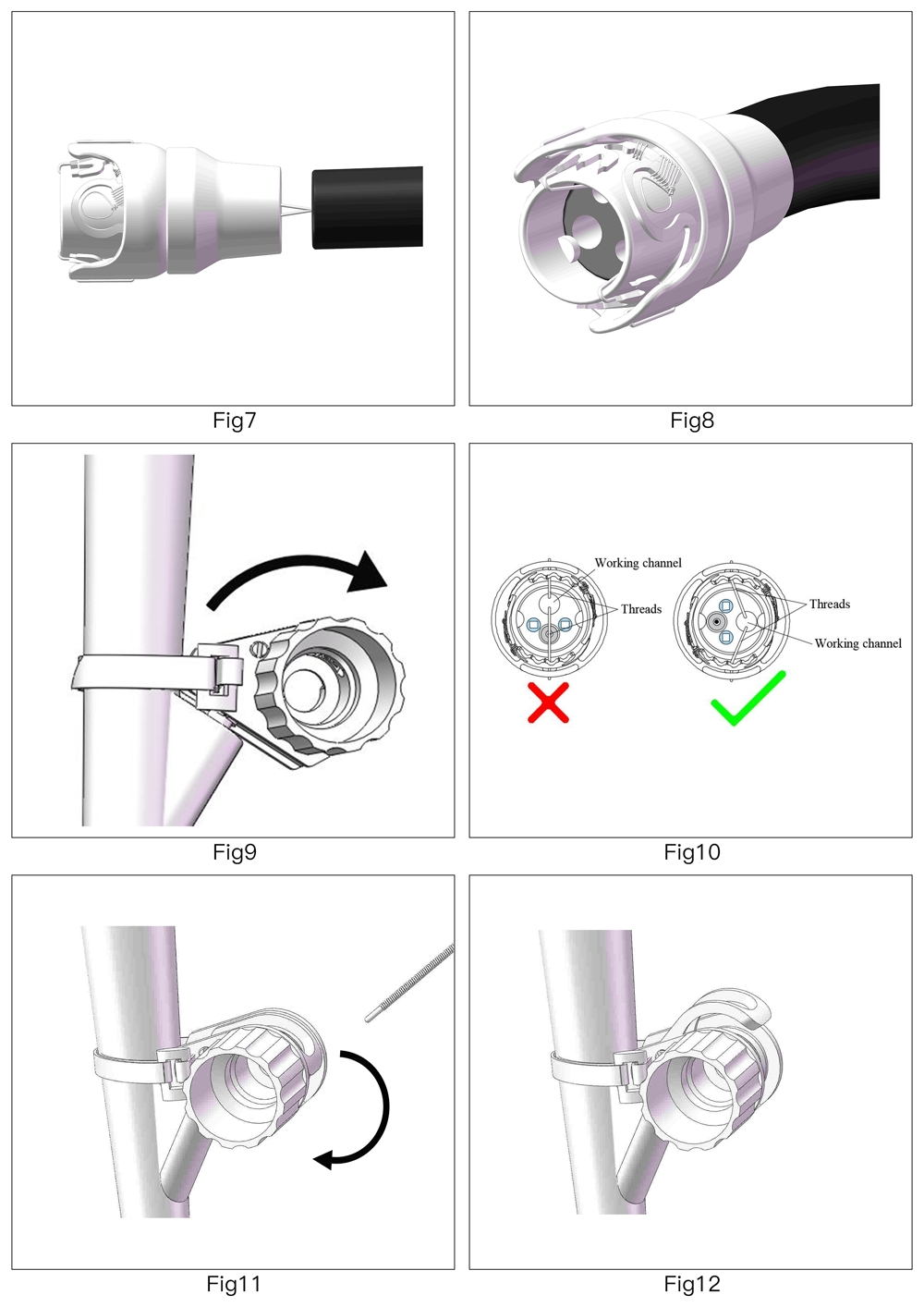
5. Put the thread knot into the releaser’s corresponding hole and wind it up until the applicator cap touches the endoscope tip. (Figure 5 & Figure 6 & Figure 7)
6. Place applicator cap onto the endoscope. (Figure 8)
7. Push the endoscope forward until it abuts against the stoppers in the cap, rotate the reel to tighten the thread until a proper force is sensed. (Figure 9)
8. Mind position of the thread while attaching the cap onto the endoscope. The thread lengths shall be equivalent and the thread must not interfere the filed of vision. (Figure 10)
9. If another instrument is inserted into the working channel, the thread needs to be mildly tensioned. (Figure 11)
10. Before clipping, the instrument needs to be secured by lifting the lock handle up to lock the reel. (Figure 12)
[Directions for Use]
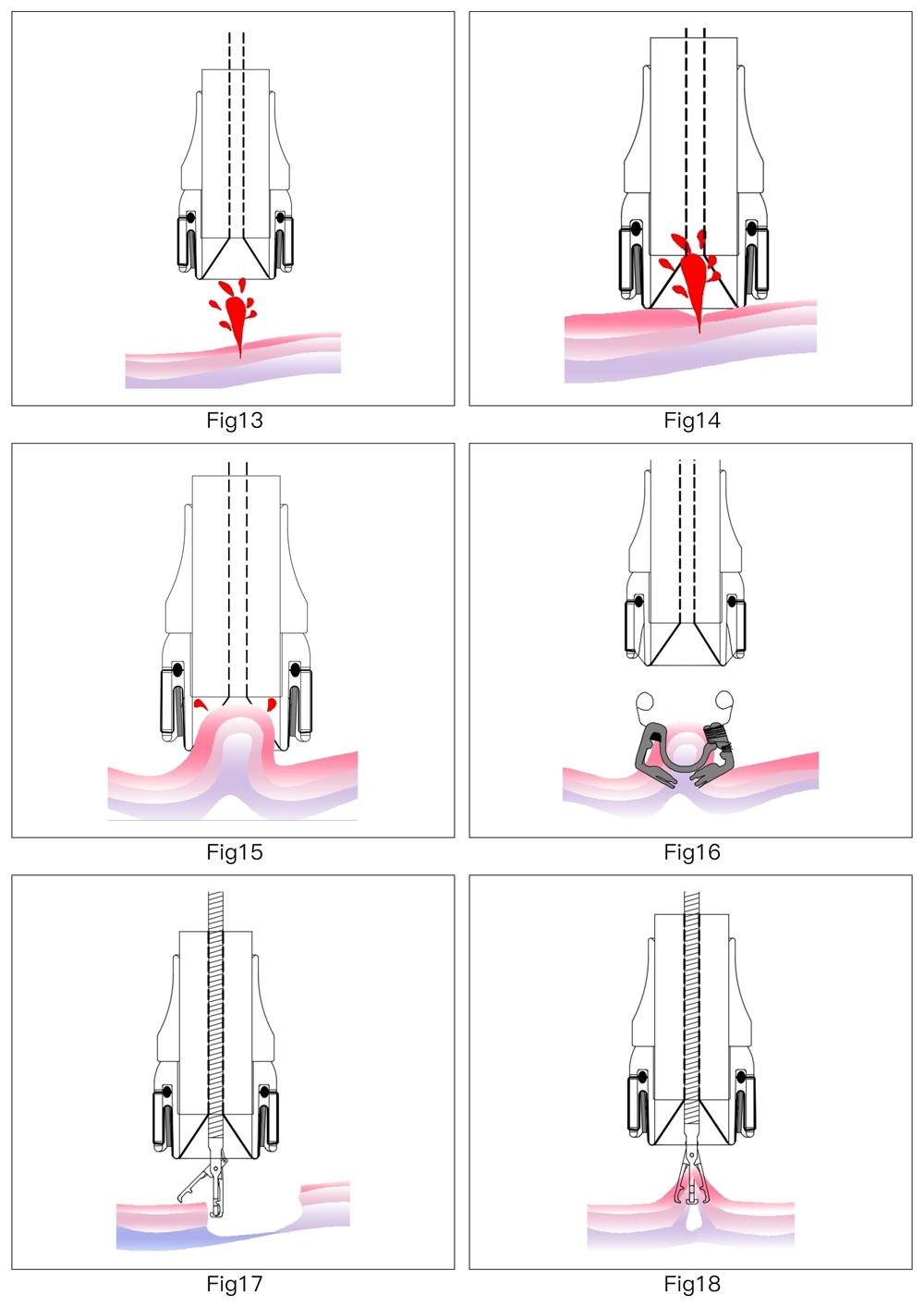
1. Deliver the endoscope with the applicator cap to the targeted lesion position. (Figure 13)
2. Bring the applicator cap in contact with the tissue. (Figure 14)
3. Suction the target tissue into the cap by simply applying endoscopic suction. (Figure 15)
Note: It recommended to release the anastomosis clip by suctioning the whole defect into the cap so that the clip does not tear the exposed muscle layer.
4. Once the target tissue is captured inside the cap, hemostasis is achieved by pressing the lock handle down and turning the reel to release the anastomosis clip around the captured tissue. (Figure 16)
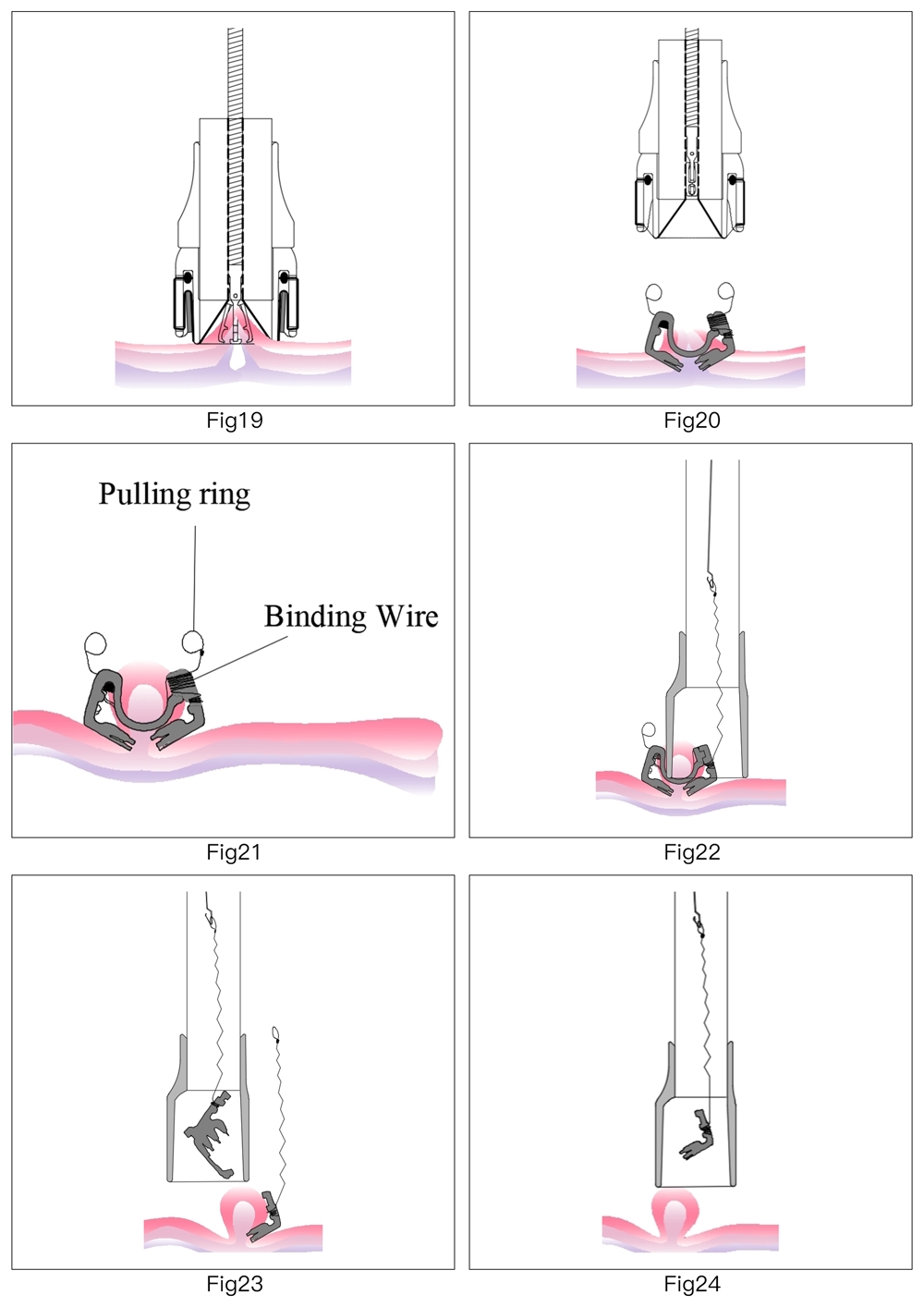
5. When performing perforation closure surgery, an application aid (Endoscopic Twin Forceps) may be needed. Grasp the perforation edges with the two Endoscopic Twin Forceps jaw parts, respectively. Retract perforation into the cap. Apply the clip and release the Endoscopic Twin Forceps. (Figure 17 & Figure 18 & Figure 19 & Figure 20)
Note: Endoscopic Twin Forceps must be fully inside cap.
6. Once the clip is released successfully, withdraw the endoscope, uninstall the releaser, and take off the applicator cap from the endoscope tip. Dispose them as medical wastes.
Note: In the case of malfunction of clip releasing, withdraw the endoscope and replace a new applicator cap with an anastomosis clip.
7. After the lesion tissue is healing, place the protector cap over the endoscope tip, guide the endoscope with the protector cap to the clip, use the wire hook or other endoscopic grasper instruments to drag the rings of binding wires for untying the clip, pull the occlusion jaw into the protector cap and retrieve it from the body. Hold the binding wire ring firmly with the wire hook or the occlusion jaw firmly with other endoscopic grasper when withdrawing the endoscope. Repeat this procedure for the second occlusion jaw. (Figure 21 & Figure 22 & Figure 23& Figure 24)
Note: The clip can spontaneously fall off or need to be removed from the body by endoscopic method within 30 days.

 +86 574-6372-9798
 overseas@senscure.net
 Building 3, Area B, No. 777, Binhai 4th Road, Hangzhou Bay New District, Ningbo City, Zhejiang Province


 Home
Home